Pre-validated Yocto BSP, IEC 62304 §8 SOUP records, and ISO 14971 FMEA for Linux-based medical devices — written by an upstream Linux kernel contributor.
Medical device companies building on Linux face the same bottleneck: SOUP records for every kernel driver used in the device. Regulatory consultants charge €50k+ and still don't understand the kernel source.
Manually documenting kernel drivers for IEC 62304 §8 takes months per product. Each kernel version bump restarts the process.
Traditional regulatory consultants know the standard but cannot read kernel source. They ask your engineers to document everything manually.
Every LTS kernel upgrade requires re-validating SOUP records. Without automation, teams avoid upgrades — leaving security vulnerabilities unpatched.
Deliverables are written by someone with active upstream kernel contributions and IEC 62304 medical device experience — not a generic regulatory consultant.
Auto-generate IEC 62304 §8 SOUP records for any Linux kernel driver directly from the source tree. Used to produce all SOUP deliverables in the packages above.
MODULE_* macros · copyright holders · kernel version · official maintainers · Kconfig dependencies · commit history · CVE search links
SOUP records are only credible if the author understands what the driver actually does. Regulatory consultants don't read kernel C. This service does both.
Bridge any Linux IIO biosignal device to a ROS 2 surgical robot or monitoring system — complete open source stack, IEC 62304 documented.
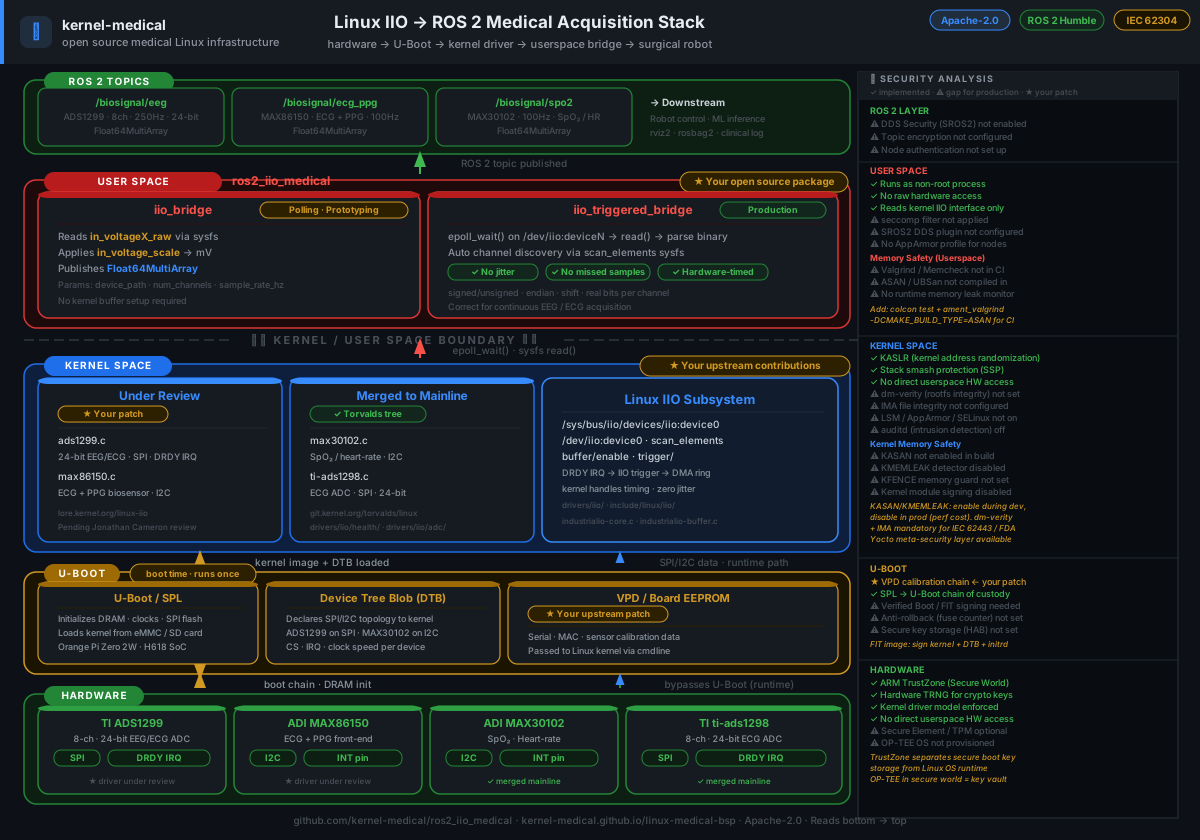
Linux IIO driver for your biosignal ADC — SPI/I2C, DMA ring buffer, hardware interrupt trigger. Submitted upstream so you get free maintenance forever.
ros2_iio_medical reads the IIO kernel buffer via epoll — hardware-timed, no missed samples — and publishes typed ROS 2 topics for robot control or clinical logging.
SOUP records, SRS, SDS, FMEA for both the kernel driver and the ROS 2 bridge — ready to hand to your regulatory team.
A complete example of what kernel driver work looks like end-to-end in a medical context.
The Texas Instruments ADS1299 is the dominant EEG/ECG acquisition chip used in medical BCI devices (OpenBCI, research-grade EEG headsets). No upstream Linux driver existed — medical device teams were each writing their own out-of-tree driver, with no shared maintenance and no compliance trail.
Wrote a full IIO subsystem driver for the ADS1298/ADS1299 family, submitted to the Linux kernel mailing list. Simultaneously generated the IEC 62304 §8 SOUP record using kernel-soup-gen — covering MODULE_*, Kconfig dependency, git history, maintainer contacts, and CVE search links. All fields verifiable directly from the kernel source tree.
Driver submitted to mainline Linux (IIO subsystem, Jonathan Cameron reviewing). Once merged: every medical device team using ADS1299 gets an upstream-maintained driver with a full SOUP record generated in under one second. Zero per-team duplication of compliance work.
Describe your hardware platform, target kernel version, and regulatory class.
Response within 1 business day.